

Field differences in the application of intake filters and oil-water separators for ESV rotary vane pumps
I.Core Definition and Function (The Most Essential Difference)
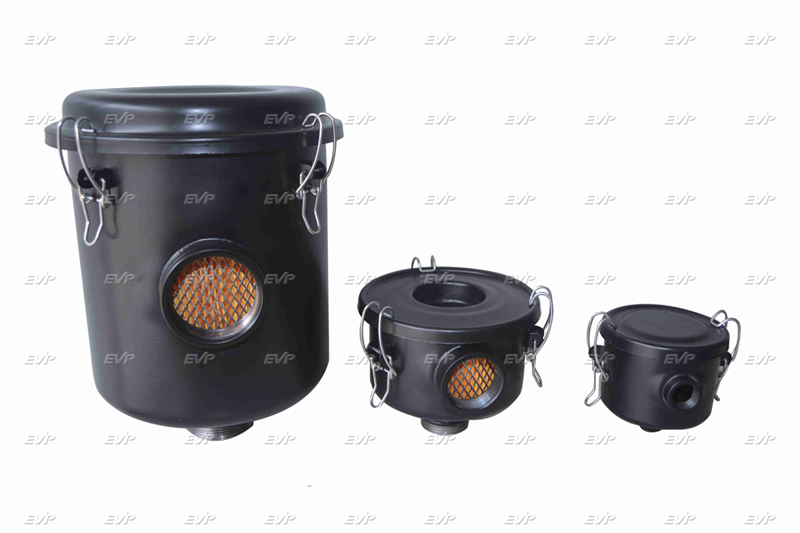
1. Air Filter (Dust Filter)
Processing Object: Solid Impurities (Dust, Weld Spatter, Rust, Powder, Particles)
Principle: Filter Element Interception and Filtration (Paper / Fiberglass / Stainless Steel Sintered Filter Screen), Only blocks solids, unable to separate liquid water, liquid oil stains, condensate.
Protection Object: Prevent solid particles from scratching rotors, cylinder inner walls, bearings, avoiding pump body wear and jamming.
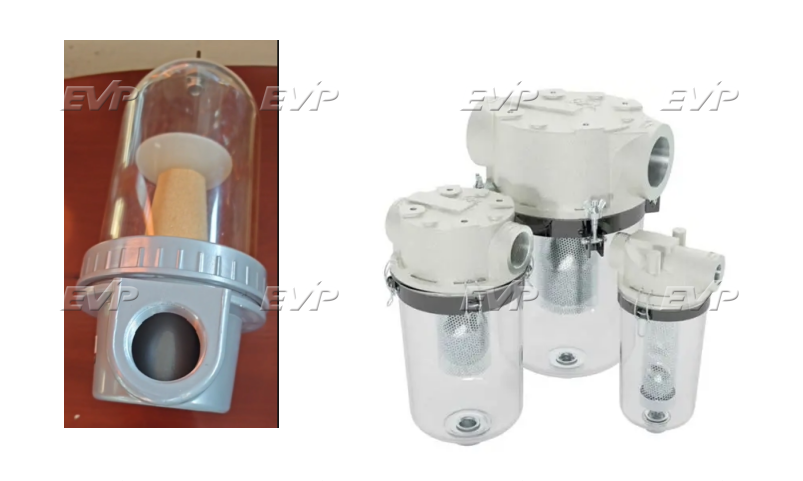
2.Air-water / Air-liquid Separator
Processing Object: Liquid media (free water droplets, condensate water, cutting fluid, process waste liquid, liquid oil droplets)
Principle: Centrifugal swirling + gravity sedimentation. Large liquid droplets collide with the cylinder wall and accumulate at the bottom storage chamber, with manual/automatic liquid discharge; gas enters the vacuum pump from the middle, basically not intercepting fine dust.
Protection Object: Prevent liquid from entering the pump chamber, avoid emulsification of vacuum pump oil, liquid impact, sudden drop in extreme vacuum, and rapid deterioration and scrapping of oil; the gas isolation valve can only handle water vapor, and cannot prevent liquid water accumulation.
II.Precise Application of Working Conditions by Scenarios
(1) Scenarios where only the [Intake Filter] is used (dry and clean gas)
- For conventional vacuum packaging, resin degassing, laboratory vacuuming, leak detection stations, the gas being drawn is dry, free of water accumulation, and contains no liquid medium, with only a small amount of floating dust in the air and rust on the pipeline;
- In clean workshops, vacuum coating, ordinary negative pressure transportation, the gas source is dry and free of condensation;
- For old pipelines, welding residue of slag, and air-suction cavities for sandblasting, special protection is required for solid abrasive particles;
- The original factory standard comes with a built-in metal coarse filter screen. When the dust is too large, a precision intake filter can be added.
Configuration scheme: Only intake filter + pump’s built-in exhaust oil mist separator
(2) Scenarios where an [intake oil-water separator] must be installed (containing water / containing liquid media)
- Oven drying, water treatment vacuum dehydration, steam operation, humid hot environment vacuum extraction, large amounts of condensation water on pipelines;
- Chemical solvent extraction, water-cooled vacuum chamber, cooling water leakage, vacuum pipeline of VD smelting furnace (large amount of water vapor);
- Water washing process, negative pressure recovery of cutting fluid, material extraction, air flow carrying a large amount of liquid droplets;
- Even if the gas shutoff valve is opened, continuous high water vapor conditions still cause oil emulsification. The pre-separator is a hard protective measure.
Configuration plan: Oil-water separator as the main component, with a simple filter in front (to prevent impurities from blocking the separator’s discharge port)
(3) Harsh working conditions: Two-stage series connection (filter + oil-water separator installed together)
Powder drying, wet spray vacuum extraction, negative pressure suction of acid washing tank, outdoor humid vacuum system. Arrangement sequence: Vacuum chamber → Inlet filter (to prevent dust) → Oil-water separator (to block liquids) → SV pump inlet
III. Core Advantages
Intake Filter
1. Prevents mechanical wear of the pump body and protects the rotor and cylinder from being scratched by particles. It can intercept rust, welding slag, powders, and solid particles, significantly extending the service life of the pump core. It is an indispensable basic protection in dry dust conditions.
2. Simple structure and low maintenance cost. It is mostly in a filter cartridge structure, small in size, and easy to install. When the filter cartridge gets dirty, it can be blown clean and reused. After damage, the cost of replacing the parts is low, and the maintenance time is short.
3. Stable and controllable gas pressure drop. The high-quality glass fiber and stainless steel filter screens have good fluidity. During normal operation, there will be no significant negative pressure loss, and it has little impact on the pump’s suction speed and maximum vacuum.
4. Suitable for most normal temperature and dry conditions. Vacuum packaging, leak detection, coating, and regular degassing and other clean gas source scenarios. Just installing this one can meet the pre-filtering requirements, simplifying the pipeline and reducing the cost of the entire equipment.
5. Generally better thermal resistance. The metal filter screen type can withstand high-temperature smoke and dry hot air currents, and is not prone to deformation and failure.
Shortcomings compared: Unable to separate liquid water and liquid oil droplets. When encountering liquids, they will directly penetrate into the pump body.
Intake oil-water (gas-liquid) separator (droplet interception)
1. Prevent vacuum pump oil emulsification and liquid impact damage. By relying on centrifugal force and gravity sedimentation, liquid water, condensate, and liquid oil contaminants can be intercepted at the source, preventing the oil from becoming cloudy and emulsified. This also reduces the frequency of vacuum pump oil replacement, saving a significant amount of oil consumables over the long term.
2. Share the workload of the gas isolation valve. The gas isolation valve can only disperse water vapor but cannot handle liquid accumulations. The separator first intercepts the liquid, and the gas isolation valve only needs to handle trace amounts of water vapor. The vacuum performance of the pump becomes more stable, and there will be no continuous decline in vacuum degree.
3. Equipped with a liquid storage chamber and a drainage structure, it is convenient to collect and discharge the liquid. The cylinder body has a liquid accumulation chamber and is equipped with manual/automatic drainage valves. It can discharge the accumulated oil and water at regular intervals without the need to disassemble the pipeline to clean the liquid. It is suitable for continuous 24-hour operation in drying, wet process, and vacuum systems for smelting.
4. Strong resistance to humid harsh environments. Humid environments, water-cooled cavities, steam evaporation, water washing processes, etc., are the most economical and effective pre-treatment solutions for protecting rotary vane pumps. The failure rate is significantly reduced.
5.Not prone to clogging. By relying on physical sedimentation to separate liquids, there is no fine filter structure. In conditions with little dust, there is almost no problem of blockage. Long-term continuous operation is more worry-free.