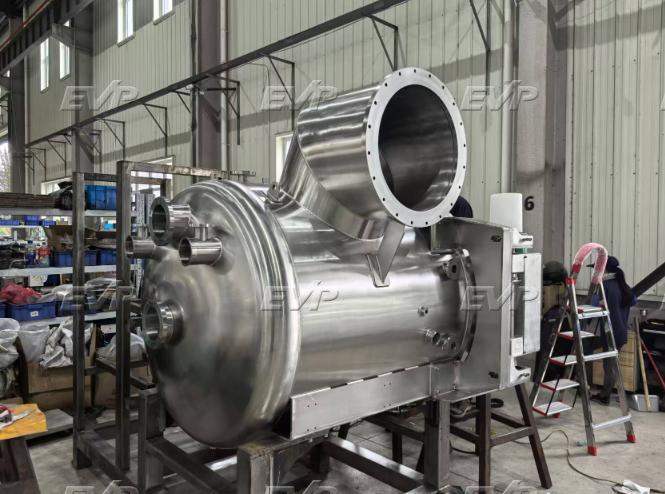
Principle of Vacuum Chamber and Its Functions in Vacuum Systems
Principle of the Vacuum Chamber
A vacuum chamber is a device specifically designed to generate a vacuum environment, primarily consisting of a hermetically sealed vessel and an exhaust system. Within the vacuum chamber, the exhaust system extracts gas from the vessel to reduce the internal pressure, thereby creating a vacuum environment.
The operating principle of a vacuum chamber is based on the Ideal Gas Law. According to this law, at a constant temperature, the pressure of a gas is inversely proportional to its volume. By extracting gas from the vessel, the mean free path of gas molecules is significantly extended, which reduces the collision frequency between molecules, ultimately forming a vacuum environment.
In general industrial applications, a vacuum chamber refers to an integrated reaction vessel that evacuates a reactor via vacuum equipment to enable physical and chemical reactions of materials under vacuum conditions. It supports processes such as vacuum feeding, vacuum degassing, and vacuum concentration. Customizable structural designs and parameter configurations can be implemented to meet specific process requirements, achieving functions including heating, cooling, evaporation, and variable-proportion mixing under vacuum. Featuring rapid heating, high temperature resistance, corrosion resistance, low environmental pollution, automatic heating, and easy operation, it is one of the commonly used reaction equipment in industries such as food processing, biopharmaceuticals, and fine chemicals, for process reactions including vulcanization, alkylation, hydrogenation, condensation, and polymerization.
Vacuum chambers are widely applied in scientific experiments, manufacturing, medical equipment and other fields. For example, they are used in the production of clean semiconductor materials, high-precision components, and high-vacuum electronic tubes. Additionally, vacuum chambers are utilized in medical devices such as MRI and CT scanners, as they can provide a clean, oxygen-free environment.
Structural Features of Vacuum Chambers
The structural design must ensure no buckling under vacuum conditions, which imposes strict requirements on the thickness and defect tolerance of steel materials.
The shaft seal of the reactor adopts a special hygienic-grade mechanical seal design, with optional packing seal and magnetic seal configurations. This high-sealing performance prevents external air from entering the chamber to avoid affecting the reaction rate, while keeping the materials free from contamination.
Polyurethane and rock wool are used as thermal insulation materials, and the chamber is equipped with a hygienic-grade pressure gauge.
Multiple heating methods including electric heating, internal/external coil heating, and thermal oil circulation heating are available to meet the process requirements of different working environments such as acid resistance, alkali resistance, high temperature resistance, and corrosion resistance.
The vacuum system is a interlocked system composed of vacuum pumps, circulating water tanks, buffer tanks, check valves and other components that operate in coordination.
Functions of the Vacuum Chamber in a Vacuum System
The vacuum chamber plays an indispensable role in a vacuum system as one of its core components. It enables precise control of vacuum degree and gas flow, while protecting other system components from external environmental interference. The EVP Vacuum team elaborates on its key functions as follows:
Pressure Regulation: The fundamental function of a vacuum chamber is to maintain a stable internal vacuum degree. In a vacuum system where the number of gas molecules is extremely low, vacuum chambers work in conjunction with vacuum pumps to extract residual gas. Without a vacuum chamber, it is impossible to accurately control and adjust the internal pressure of the system to maintain a stable vacuum level.
Pipeline Interconnection: A vacuum chamber can not only directly connect multiple vacuum equipment, but also serve as a manifold to link different pipelines, thus constructing a complete vacuum system. Customizable machining of the chamber can accommodate different sizes and shapes of equipment, enabling seamless pipeline connections between various components.
Gas Separation and Purification: The vacuum chamber facilitates gas separation to ensure stable gas flow in the system. For instance, in certain research experiments that require precise control of the quantity and proportion of different gases, the vacuum chamber can achieve this objective. Meanwhile, it can filter exhaust gas and impurities through microporous filtration to maintain high gas purity.
Temperature Control: Vacuum chambers can realize precise temperature regulation through dedicated structural designs. In ultra-low temperature research scenarios that require components to be placed in cryogenic environments, the vacuum chamber can be equipped with specific structures such as liquid nitrogen funnels to reduce the internal temperature to the required extremely low level.
Component Protection: The vacuum chamber shields other system components from external environmental impacts. For example, in particle acceleration research that requires high-vacuum conditions for particle acceleration, the vacuum chamber protects other sensitive components that cannot withstand such high-vacuum environments from damage.
Automation Enablement: Vacuum chambers are critical for automated equipment operation. Taking laser cutting machines as an example, the cutting process can only be carried out after the workpiece is placed in a high-vacuum environment, which is automatically realized through the coordinated operation of vacuum pumps and vacuum chambers.
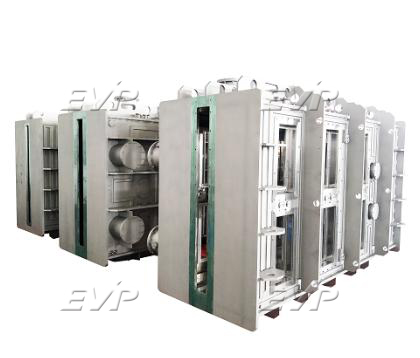
In summary, vacuum chambers are of vital importance in vacuum systems. They not only maintain a stable internal vacuum degree, but also integrate different components, separate gases, control temperature, and protect other system parts. The application of vacuum chambers significantly improves the efficiency and quality stability of laboratory research and industrial production.
The EVP team provides customized vacuum chamber services. If you have any requirements, please provide your drawings, material specifications, leak rate requirements, surface treatment standards, and any other special demands. Our professional team will deliver high-quality products and services for you.