

Technical Analysis: Vapor Phase Drying (VPD) Technology for Capacitors
1.What is Vapor Phase Drying (VPD) Technology?
Vapor Phase Drying is a drying method that utilizes low-boiling point solvent vapors to condense and release latent heat within a vacuum or controlled environment. This process enables the rapid vaporization and removal of surface moisture from the target objects. Unlike traditional heating methods, this process does not rely solely on high temperatures but completes the drying cycle through phase-change energy transfer, making it significantly gentler on the workpieces. In practical systems, VPD typically operates in synergy with vacuum systems, condensation recovery units, and solvent circulation modules to form a highly controllable closed-loop process.
2.Why Use “Vapor Phase” for Capacitor Manufacturing?
In the production of high-voltage capacitors, instrument transformers, and power transformers, insulation materials (such as capacitor paper, laminated wood, and pressboard) easily absorb ambient moisture. If this moisture is not thoroughly removed, local discharges may occur under high-voltage environments, leading to dielectric breakdown and destruction of the capacitor. Traditional vacuum hot-air drying relies on air for heat transfer. However, in a vacuum, the air is thin and heat conduction is extremely slow, often resulting in “dry on the outside but wet on the inside.” The advantage of VPD lies in using a gaseous medium (kerosene vapor) to release heat through condensation inside the high-vacuum chamber. Since vapor is omnidirectional and pervasive, heat can penetrate rapidly and uniformly into the deepest layers of the capacitor core.
3.Core Process Flow (Four Stages)
A complete VPD cycle typically takes dozens of hours and is divided into the following key steps:
①Preparation Phase (Prep-Vacuum)
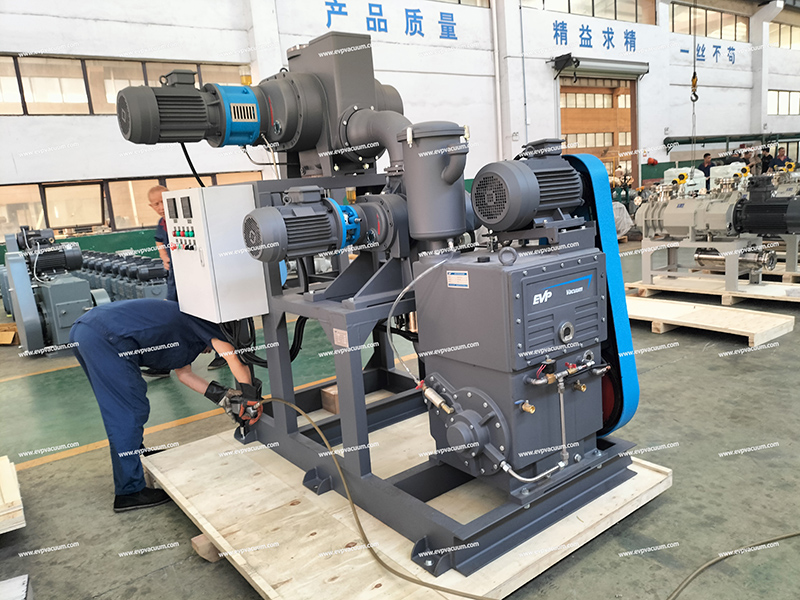
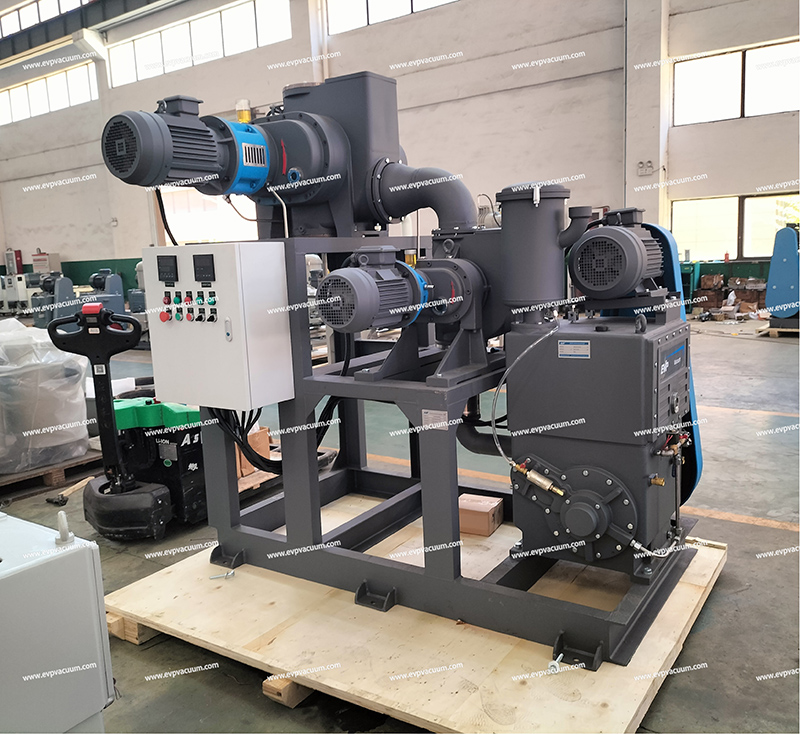
The EVP vacuum pump system (usually a combination of Rotary Piston/Rotary Vane pumps + Roots booster pumps) is started to reduce the drying chamber pressure to approximately 100 Pa.
The objective is to evacuate air to prevent the kerosene vapor from contacting oxygen, which could cause oxidation or explosions during the subsequent heating phase.
②Heating and Exchange Phase
Core Medium: High-purity specialized kerosene is used.
Kerosene is heated to 130–150°C in an evaporator until it vaporizes, after which the vapor enters the drying chamber.
Phase-Change Heat Release: When the kerosene vapor encounters the cooler capacitor core, it reliquefies, releasing massive amounts of latent heat. This “liquid-gas-liquid” cycle is extremely efficient.
③Pressure Reduction and Moisture Removal Phase
Once the core temperature reaches the preset value, the vapor inflow is stopped.
The vacuum system is activated to extract gases and lower the chamber pressure. At this point, the heat absorbed by the core causes moisture and residual kerosene to vaporize rapidly and be evacuated.
④High-Vacuum Deep Drying
The Ultimate Sprint: This is the critical benchmark for vacuum system performance. The system must reduce the pressure to 10 Microns (1.33 Pa) or even lower (e.g., 0.2 Microns).
At this stage, chemically bound water in the insulation materials is thoroughly removed. Drying success is finally determined by measuring the “water extraction rate” or the “pressure rise test.”
4.Hardware Configuration: A Typical VPD Unit
| Unit component | Functions |
| Vacuum dryer | The core airtight vessel designed to withstand high-vacuum pressure. |
| Vacuum Package | Rotary piston vacuum pump/rotary vane vacuum pump(backing pump)+ roots vaacuum pump(booster)。Required to handle high volumes of moisture and kerosene vapor. |
| Kerosene heating and evaporation system. | Equipped with electric or thermal oil heaters to convert liquid kerosene into vapor. |
| Condensation Recovery System | Uses a condenser to separate and recover evacuated kerosene vapor and moisture. |
| Control System (PLC) | Precisely controls vacuum levels and temperature curves to ensure production safety. |
5.Industry Outlook
As global power grids evolve toward Ultra-High Voltage (UHV), the demand for high-voltage AC/DC capacitors is surging. This trend is driving the need for vacuum systems with higher pumping speeds and lower ultimate pressures.
Furthermore, as advanced manufacturing trends toward being “cleaner, more precise, and more reliable,” Vapor Phase Drying is gradually moving from a niche process to mainstream application. Its deep integration with vacuum technology not only improves drying quality and process consistency but also provides new directions for vacuum system integration and application expansion.
It is foreseeable that with the continuous advancement of EVP vacuum equipment technology and system integration capabilities, Vapor Phase Drying will play a pivotal role in more high-value-added sectors.