

Application of Liquid Ring Vacuum Pumps in Vacuum Priming Systems
In municipal water supply, agricultural irrigation, power plant circulating water, fire protection systems, and industrial cooling water applications, centrifugal pumps are widely used due to their simple structure and high flow capacity. However, when a centrifugal pump is installed above the liquid level, it cannot self-prime. Before startup, the air inside the suction pipeline and pump casing must be evacuated to create a vacuum, allowing the liquid to be drawn into the pump. This process is known as vacuum priming.
Thanks to their reliable performance, excellent tolerance to moisture, and ability to handle demanding operating conditions, EVP liquid ring vacuum pumps have become one of the most widely used and proven vacuum solutions for vacuum priming systems.
Working Principle of Vacuum Priming
The primary purpose of a vacuum priming system is to quickly remove air from the suction pipeline before the centrifugal pump starts.
The operating process is as follows:
1.Start the liquid ring vacuum pump.
2.The vacuum pump continuously evacuates the air from the suction pipeline and the centrifugal pump casing.
3.As negative pressure is created inside the pipeline, atmospheric pressure forces the liquid into the suction line.
4.Once the suction pipeline and pump casing are completely filled with liquid, the priming process is complete.
5.The centrifugal pump starts normal operation, while the liquid ring vacuum pump either stops or switches to standby mode.
For pumping stations that require frequent starts and stops or unattended operation, automatic vacuum priming systems are commonly installed. These systems integrate automatic priming, automatic start/stop functions, and liquid level monitoring, significantly improving operational efficiency and automation.
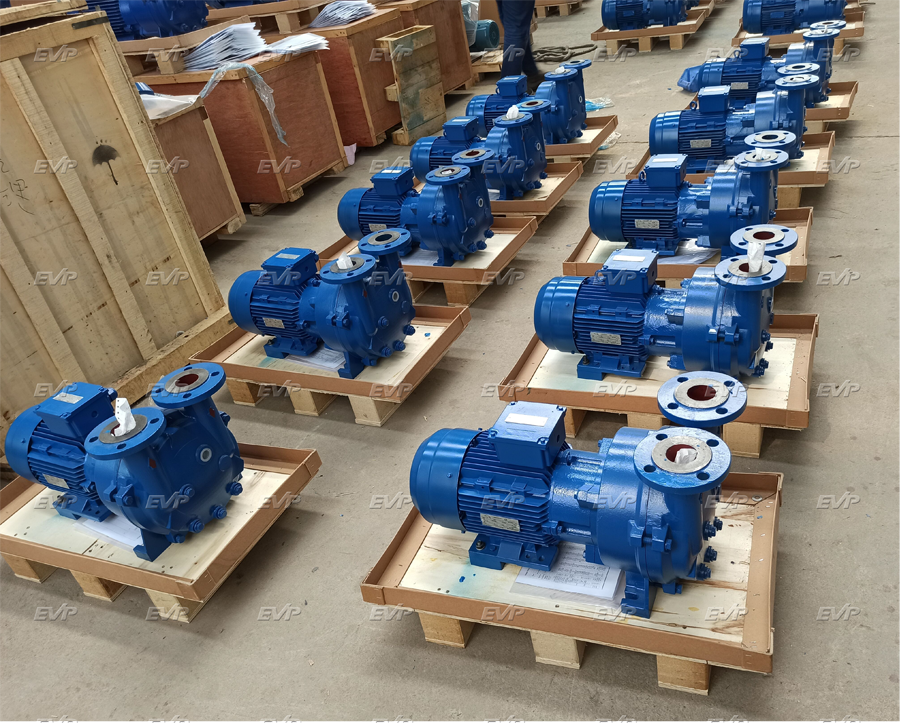
Why Choose a Liquid Ring Vacuum Pump?
Compared with rotary vane vacuum pumps and dry vacuum pumps, liquid ring vacuum pumps offer several advantages that make them particularly suitable for vacuum priming applications.
1. Capable of Handling Air–Water Vapor Mixtures
During the priming process, the vacuum pump removes not only air but also a considerable amount of water vapor and occasionally small quantities of liquid.
Since a liquid ring vacuum pump uses a sealing liquid as its working medium, it is inherently resistant to moisture and liquid carryover, making it an ideal choice for vacuum priming applications.
2. Stable Operation and Continuous Duty Capability
Large pumping stations and circulating water systems often require vacuum equipment capable of continuous operation.
With no metal-to-metal contact between the main moving components, liquid ring vacuum pumps operate smoothly with low vibration and are well suited for long-term continuous service, requiring relatively little maintenance.
3. Easy Maintenance
Liquid ring vacuum pumps feature a simple mechanical structure without complicated lubrication systems, making routine maintenance straightforward.
Their reliability has been proven over decades of operation in municipal water supply systems and industrial pumping stations.
4. High Tolerance to Dust and Minor Contaminants
In some water intake environments, the extracted gas may contain dust, moisture, or small amounts of impurities.
Compared with dry vacuum pumps, liquid ring vacuum pumps are generally more tolerant of these conditions, ensuring reliable performance even in relatively harsh environments.
Typical Applications
Liquid ring vacuum priming systems are widely used in:
Municipal water supply pumping stations
Flood control and drainage pumping stations
Agricultural irrigation systems
Fire water supply systems
Power plant circulating cooling water systems
- Petrochemical circulating water stations
- Mine dewatering systems
- Port facilities and marine ballast water systems
For large pumping stations, it is common to use one liquid ring vacuum pump to serve multiple centrifugal pumps through a centralized vacuum system. Combined with a vacuum tank, level controller, and PLC control system, fully automatic priming can be achieved.
Development Trends
With the advancement of smart water management and industrial automation, modern vacuum priming systems are evolving toward higher reliability, intelligent control, and improved energy efficiency.
More projects are adopting PLC control, variable frequency drives (VFDs), and remote monitoring technologies, allowing vacuum pumps to operate only when needed, thereby reducing energy consumption and maintenance costs. Meanwhile, continuous improvements in liquid ring vacuum pump design are enhancing pumping efficiency while reducing operating noise, further strengthening their competitiveness in vacuum priming applications.
Conclusion
With their excellent moisture tolerance, stable performance, easy maintenance, and continuous-duty capability, liquid ring vacuum pumps have become the preferred solution for vacuum priming systems.
Whether used in municipal water supply, agricultural irrigation, power generation, petrochemical processing, or mining operations, a properly designed liquid ring vacuum priming system can significantly improve centrifugal pump startup reliability, reduce maintenance requirements, and enhance overall system efficiency.
As automation technologies and energy-efficient designs continue to advance, liquid ring vacuum pumps will remain an essential component of vacuum priming systems, providing reliable and efficient vacuum solutions for a wide range of fluid handling applications.