

Application of the EVP vacuum pump in the battery industry
Vacuum technology is an indispensable key process in modern battery manufacturing, directly influencing battery performance, safety, and consistency. From raw material processing to final packaging, vacuum pumps and their systems are integral to multiple critical stages of battery production.
I. Why is vacuum required in battery manufacturing?
Battery manufacturing is a process that demands extreme purity and precision, with vacuum technology serving as the foundation for achieving these objectives. In simple terms, the primary function of a vacuum pump is to create and maintain a “pure” environment free of gases, moisture, and impurities, thereby fundamentally ensuring the high performance, safety, and consistency of modern batteries.
II. Process Stage:
| Process Stage | Core Application Process | pivotal role | Main Challenges/Requirements |
| Electrode Manufacturing (Front End) | Raw material transportation, slurry mixing and degassing, electrode coating and drying | Prevent bubble formation, ensure slurry uniformity and purity, and rapidly remove solvents and moisture. | The bubbles in the slurry and the volatile NMP solvent are corrosive to copper components. |
| Cell Assembly (Middle Section) | Stacking/winding packaging of electrode sheets, cell casing/encapsulation, electrolyte filling and degassing | Vacuum-adhered positioning electrode sheets to remove moisture and oxygen, ensuring uniform electrolyte wetting and elimination of bubbles. | During the injection process, exposure to corrosive electrolyte vapors (e.g., DME, LiPF₆, etc.) requires the vacuum pump to possess exceptional corrosion resistance. |
| Battery formation testing
( back end ) |
Vacuum baking drying, negative pressure melting and degassing, helium mass spectrometry leak detection | Deeply remove internal moisture (baking), extract and generate gas during formation to stabilize the SEI film (formation), and accurately detect micron-level leaks (leak detection). | It requires an ultra-high vacuum environment with high pumping speed, an oil-free and dust-free clean operating condition, and must be capable of withstanding harmful process gases. |
| Other Applications | Vacuum handling (for picking electrode sheets, etc.), vacuum packaging (for sealing pouch batteries), module PACK sealing | Achieve automated precision operations to ensure packaging quality and the overall sealing integrity of the battery pack. | High requirements are imposed on the stability and response speed of the vacuum level. |
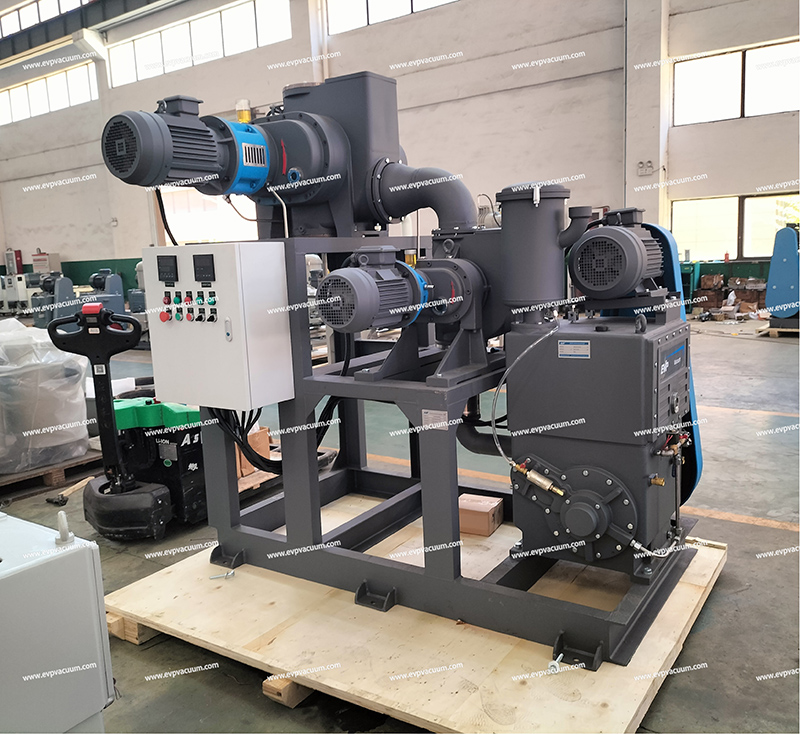
III. Common Types of Vacuum Pumps Used in the Battery Industry
| Type of vacuum pump | Main Application Process | superiority | Shortcomings/Precautions |
| EVP EDSE & EDSV Series Dry Screw Vacuum Pumps | Drying, dissolution, solution injection, degassing | It achieves an ultimate vacuum level of up to 0.05 mbar, is oil-free/pollution-free, corrosion-resistant, highly effective in handling dust/liquids, energy-efficient, and requires low maintenance costs. | The initial investment cost is relatively high. |
| EVP, EDS Series Dry Scroll Vacuum Pump | Vortex pump: electrode preparation, cell assembly, vacuum handling, encapsulation; Claw pump: stack stack | The vortex pump operates oil-free, eliminating contamination, with exceptional vacuum stability and intelligent control. | The high pumping speed capability of vortex pumps is relatively limited. |
| EVP Oil Screw Vacuum Pump | Homogenate mixing, laminated packaging | It features a wide pumping speed range (600–6000 m³/h), effectively removes dust from the slurry, and offers relatively low system costs. | Oil and gas emissions may contaminate the cleanroom environment; frequent oil changes incur high maintenance costs, and the oil is prone to contamination. |
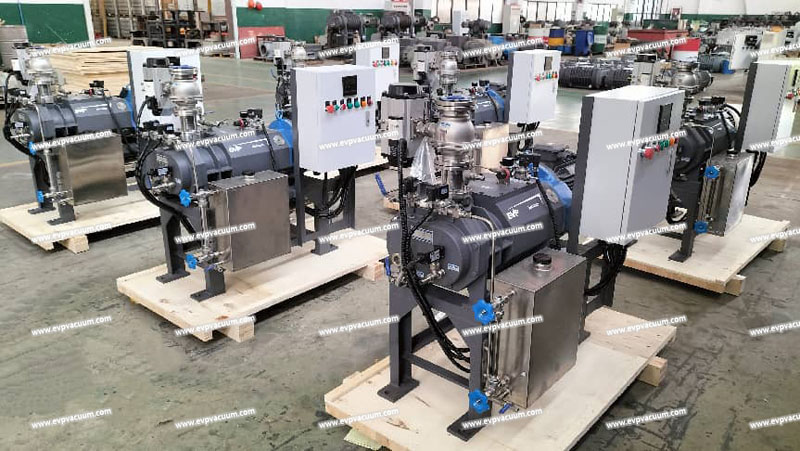
IV. Summary
The vacuum pump is a critical factor influencing battery quality, efficiency, and cost. At every stage of battery manufacturing, selecting the appropriate vacuum pump type is not only essential for ensuring product quality in the current batch but also a strategic decision impacting long-term operational costs and production stability. Therefore, pump selection should be based on specific process requirements, medium characteristics, and overall system planning.