

Application of Rotary Vane Vacuum Pump + Roots Vacuum Pump System in Liquid Nitrogen Tank Industry
With the rapid development of biological sample storage, medical cold-chain logistics, scientific research, and industrial cryogenic technologies, liquid nitrogen tanks have become essential equipment across multiple industries.One of the most critical performance indicators of a liquid nitrogen tank is its low evaporation rate and long holding time, which strongly depend on the quality and long-term stability of the vacuum insulation system.
During the manufacturing process, a single vacuum pump often fails to simultaneously achieve high pumping speed and deep vacuum performance.Therefore, the rotary vane vacuum pump + roots vacuum pump system, featuring high pumping speed, excellent ultimate vacuum, and stable operation, has become a proven and widely adopted solution in the liquid nitrogen tank industry.
I.Applications of Rotary Vane Pump + Roots Pump System in Liquid Nitrogen Tank Industry
1.High-Efficiency Evacuation of Vacuum Insulation Layer (Core Process)
Liquid nitrogen tanks typically adopt a double-wall structure, forming a vacuum insulation layer between the inner and outer vessels to minimize heat transfer and convection losses.During the initial evacuation stage, the gas volume is large and requires high pumping speed; in the later stage, a higher ultimate vacuum level is required.In the combined system:
Rotary vane pump acts as the backing pump, handling start-up and low-vacuum evacuation
Roots pump provides high pumping speed in the medium-to-high vacuum range, significantly accelerating evacuation
System Functions:
(1)Significantly reduce evacuation time
(2)Easily achieve vacuum levels ≤ 1 Pa
(3)Improve insulation performance and reduce liquid nitrogen evaporation rate
2.Evacuation of Multi-Layer Insulation (MLI) and Adsorbent Materials
High-end liquid nitrogen tanks often incorporate multi-layer insulation (MLI) or adsorbent materials inside the vacuum space, which absorb air and moisture under atmospheric conditions.The combined rotary vane + roots pump system enables deep evacuation within a reasonable time, effectively removing residual gases from material surfaces and internal pores.
System Functions:
(1)Reduce residual gas content
(2)Improve long-term vacuum stability
(3)Extend the service life of the liquid nitrogen tank
3.Vacuum Holding Test and Helium Leak Detection Support
Before final sealing, liquid nitrogen tanks must undergo vacuum holding tests and helium leak detection to ensure the integrity of welds and joints.The roots pump maintains stable pumping speed in the medium-to-high vacuum range, while the rotary vane pump ensures safe and reliable backing pressure.
System Functions:
(1)Provide a stable, low-fluctuation vacuum environment
(2)Improve sensitivity for micro-leak detection
(3)Reduce testing time and increase inspection efficiency
4.Centralized Vacuum System for Liquid Nitrogen Tank Production Lines
In large-scale production workshops, multiple tanks often require evacuation simultaneously.A centralized vacuum station can be built using rotary vane and roots pumps, supplying vacuum to multiple stations via valves and buffer tanks.
System Functions:
(1)One system supports multiple workstations
(2)Reduce equipment investment and energy consumption per unit
(3)Simplify centralized management and maintenance
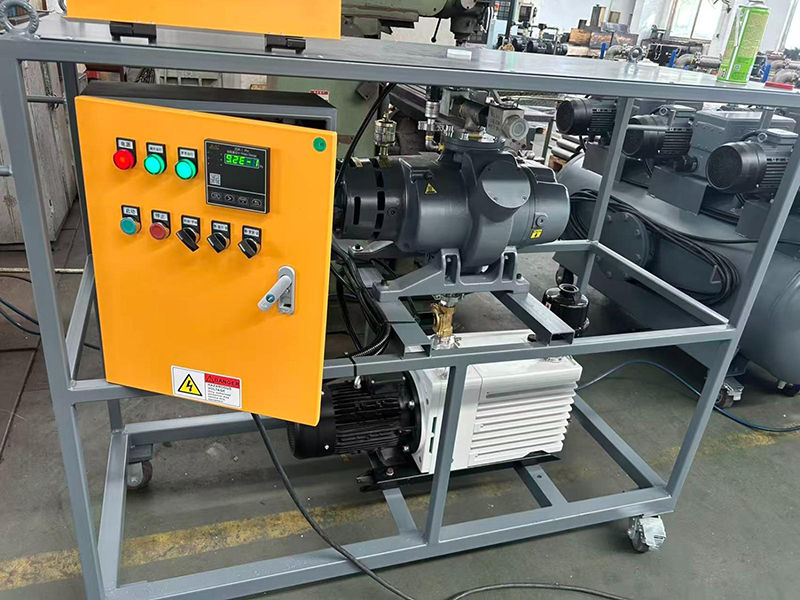
Rotary Vane Vacuum Pump + Roots Vacuum Pump
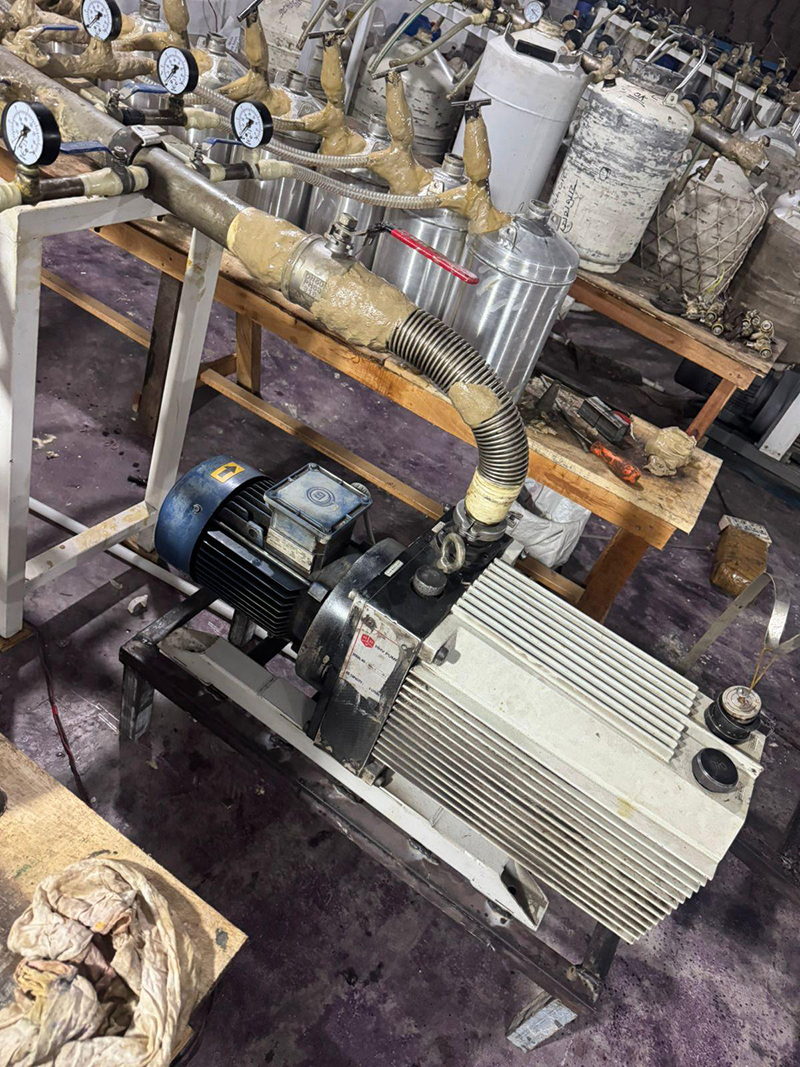
Customer site equipment diagram
II. Advantages of Rotary Vane + Roots Pump System in Liquid Nitrogen Tank Industry
1.High Pumping Speed and Efficiency
Roots pumps deliver extremely high pumping speed in the medium vacuum range. Combined with rotary vane pumps, they dramatically reduce evacuation time, especially for medium and large tanks and batch production.
2.High Ultimate Vacuum for Advanced Cryogenic Applications
With stable backing pressure, the system operates efficiently and reliably, easily achieving vacuum levels ≤ 1 Pa, suitable for research-grade and biostorage liquid nitrogen tanks.
3.Stable system operation, suitable for continuous production
Both rotary vane pumps and Roots pumps are mature industrial equipment:
(1)Simple structure, high reliability
(2)Suitable for long-term continuous operation
(3)Stable vacuum curve with minimal fluctuations
In the 24-hour production mode of liquid nitrogen tank manufacturing enterprises, the system operates stably with a low failure rate.
4.Highly adaptable to various processes, covering multiple specifications of liquid nitrogen tanks.
Whether it’s a small laboratory liquid nitrogen tank or a large biological sample storage tank, the rotary vane pump + Roots pump system can be flexibly adapted by adjusting the pump type combination and pumping speed configuration.
III. Summary
The rotary vane pump + Roots pump vacuum system, through the rational division of labor between the backing pump and the booster pump, achieves a balance between high pumping speed, high vacuum degree, and high reliability in the liquid nitrogen tank industry, and has become the mainstream solution in the liquid nitrogen tank jacket vacuum process. This system is widely used in:
(1)Liquid nitrogen tank jacket vacuuming
(2)Vacuum treatment of multi-layer insulation materials
(3)Vacuum holding test and leak detection
(4)Centralized production line vacuum system
During the selection process for liquid nitrogen tank projects, the rotary vane pump and Roots pump models should be rationally configured according to the jacket volume, target vacuum degree, evacuation time, and production line cycle time to achieve the comprehensive goals of improved insulation performance, increased production efficiency, and optimized operating costs.