

Focusing on a Carbon-Negative Future! EVP Liquid Ring Compressors Meet All Syngas Boosting Requirements
Against the backdrop of the rapid development of the carbon-negative materials industry, the efficiency and cost-effectiveness of the syngas compression stage have emerged as critical factors constraining the scalability of corporate production. It is understood that during the production of carbon-negative materials—such as cement-free concrete and carbon-negative phenolic resins—the syngas compression stage (involving a mixture of 66% H₂ and 33% CO) faces a multitude of challenges: syngas is highly flammable, explosive, and corrosive, thereby imposing extremely stringent requirements on equipment materials and sealing mechanisms. Furthermore, the process demands stable compression at high flow rates and medium-to-low pressures to ensure a continuous feed into the high-pressure reaction unit operating at 4 bar A; concurrently, it is essential to control energy consumption and maintenance costs to enhance overall production economics. Traditional liquid-ring compressors typically deliver a discharge pressure of only 3.5 bar A; consequently, meeting the aforementioned requirements necessitates the deployment of two units operating in series, a configuration that inevitably results in elevated energy consumption and operational costs.
The single-stage LRC series liquid ring compressors developed and manufactured by EVP are capable of reaching discharge pressures of up to 7 bar G, while the single-unit 2LRC series two-stage liquid ring compressors can reach up to 11 bar G. The core advantage of liquid ring compressors lies in their isothermal compression principle; the gas compression process is gentle and generates no high temperatures, allowing for the safe handling of flammable, explosive, and volatile gaseous media. Furthermore, they are well-suited for complex operating environments involving dust-laden or moisture-rich gases—a characteristic that makes them the preferred equipment across a wide range of industries.
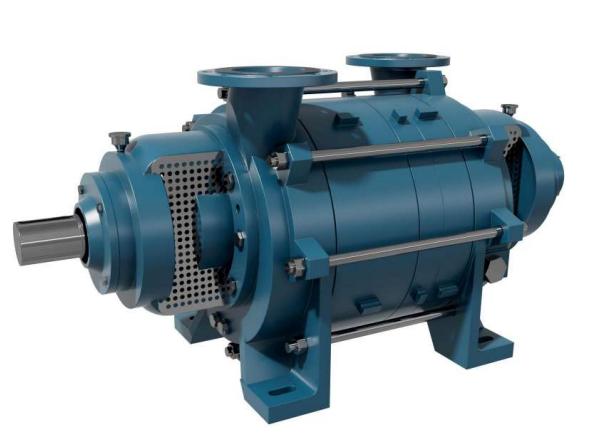
The client specializing in the R&D of decarbonization products—with a core business encompassing materials such as cement-free concrete blocks and bio-asphalt—relies on a stable supply of syngas (66% H₂ + 33% CO) for the production of these carbon-negative materials. This process specifically requires boosting the syngas pressure from 1 bar to 4 bar to meet the inlet requirements of high-pressure reaction units.
The specific process parameters are as follows:
Gas Medium: Syngas (66% H₂ + 33% CO); flammable, explosive, and requires corrosion resistance.
Flow Rate: Inlet 920–950 m³/h (corresponding to 1000 kg/h @ 1 bar, 35°C).
Pressure Requirements: Inlet 0.9–1.0 bar (a) → Outlet 4.5–5.0 bar (a);
Compression Ratio: 5:1
We recommends the LRC-20 single-stage liquid ring compressor, capable of handling a syngas inlet flow rate of 920–950 m³/h. It reliably boosts the syngas pressure from an inlet of 0.9–1.0 bar (absolute) to 4.5–5.0 bar (absolute), perfectly meeting the core requirements of the client’s High-Pressure Fixed-Bed Reactor (HPFR) unit—specifically, a working pressure of 4 bar and a pipeline pressure loss allowance of 0.5 bar—while achieving a compression ratio of 5.0:1. Constructed from SS316L stainless steel and featuring a dual-face mechanical seal design, the unit effectively resolves critical industry pain points such as syngas leakage and equipment corrosion. By doing so, it facilitates the scaled-up production of carbon-negative products—including cement-free concrete and carbon-negative phenolic resins—thereby contributing to the realization of “Dual Carbon” goals.
Complete lquid ring compressor system review picture:
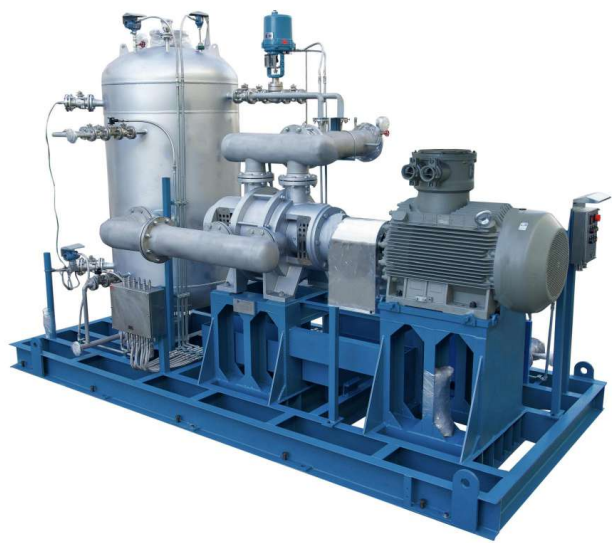
EVP liquid ring vacuum pumps and compressors can be custom-tailored—in terms of materials, operating parameters, and sealing designs—to meet the specific requirements of diverse industries and operating conditions. Whether the application involves low-pressure boosting, vacuum extraction, or the handling of specialized media, these units provide precisely matched solutions. Their application footprint spans numerous industrial sectors—including petroleum, chemicals, machinery, mining, light industry, pharmaceuticals, and food processing—establishing them as core fluid-handling equipment that serves as a vital link across various stages of industrial production.
The realization of comprehensive, multi-scenario applications for liquid ring compressors represents an inevitable trend in the evolution of industrial equipment toward greater intelligence and customization. Moving forward, EVP will continue to deepen its expertise across a wide spectrum of application scenarios, continuously optimizing product performance and introducing an expanded portfolio of customized solutions tailored to specific industry needs, thereby empowering various sectors to achieve high-quality, sustainable, and eco-friendly development.