Liquid Ring Vacuum Pumps vs. Dry Screw Vacuum Pumps: An In-Depth Study of Steam and Condensable Vapor Applications
Conclusion first: For vapor-handling applications, neither technology is inherently superior. The real dividing line is whether liquid is allowed to enter the pump or whether condensable media must be maintained in the gas phase.
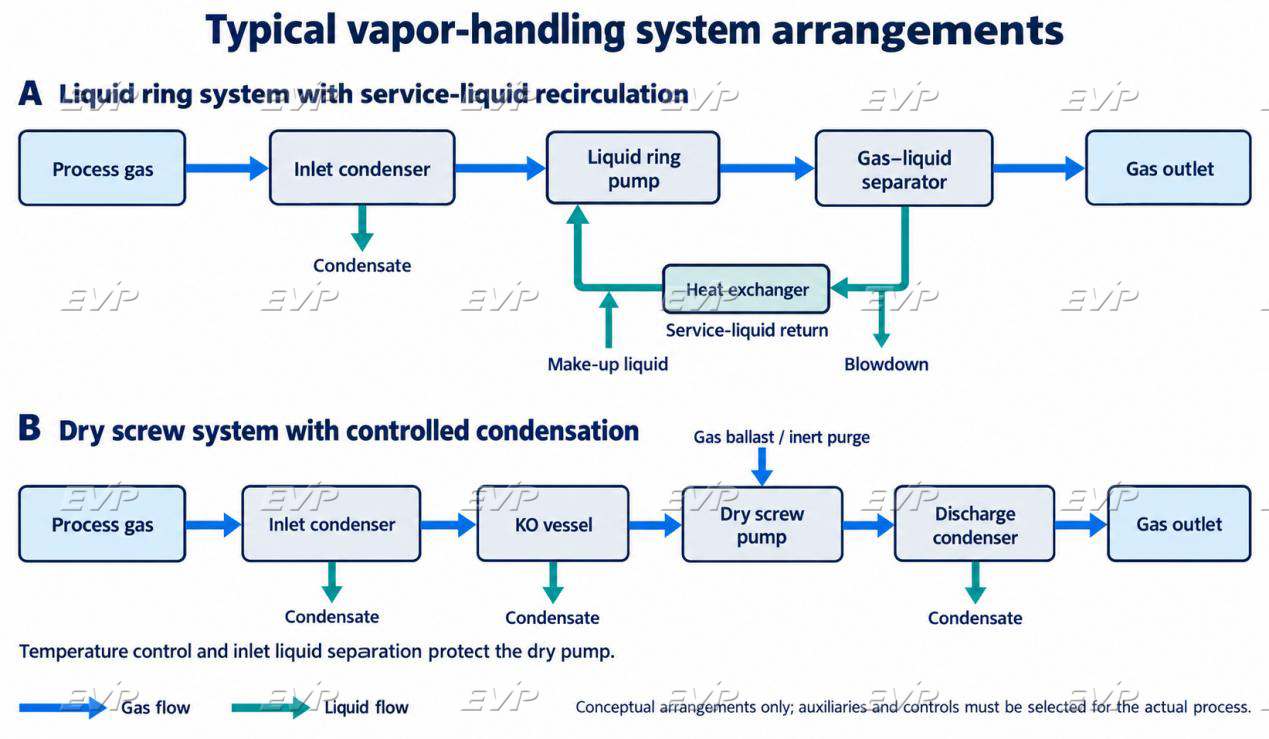
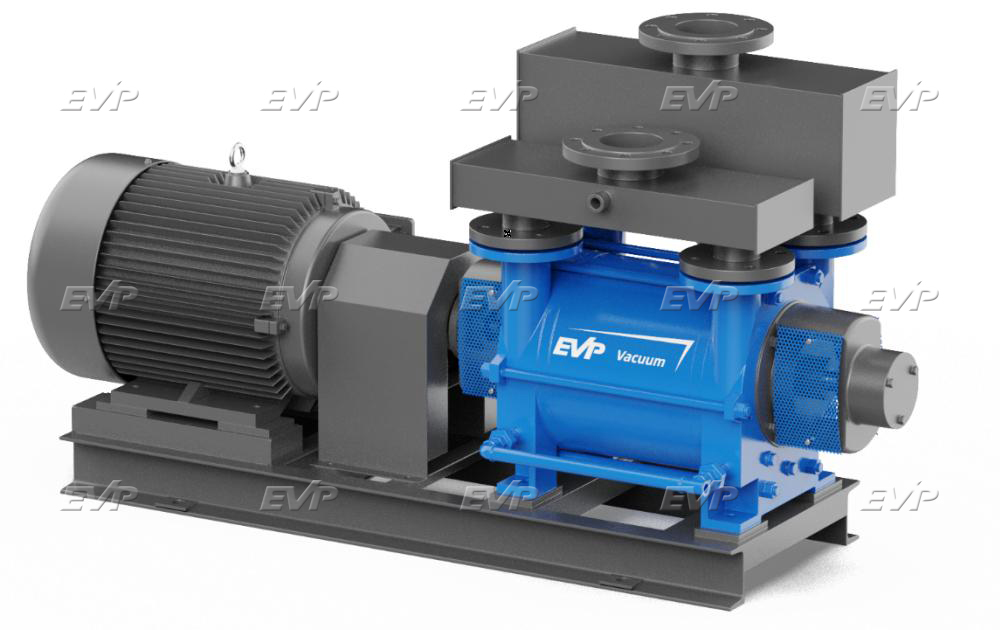
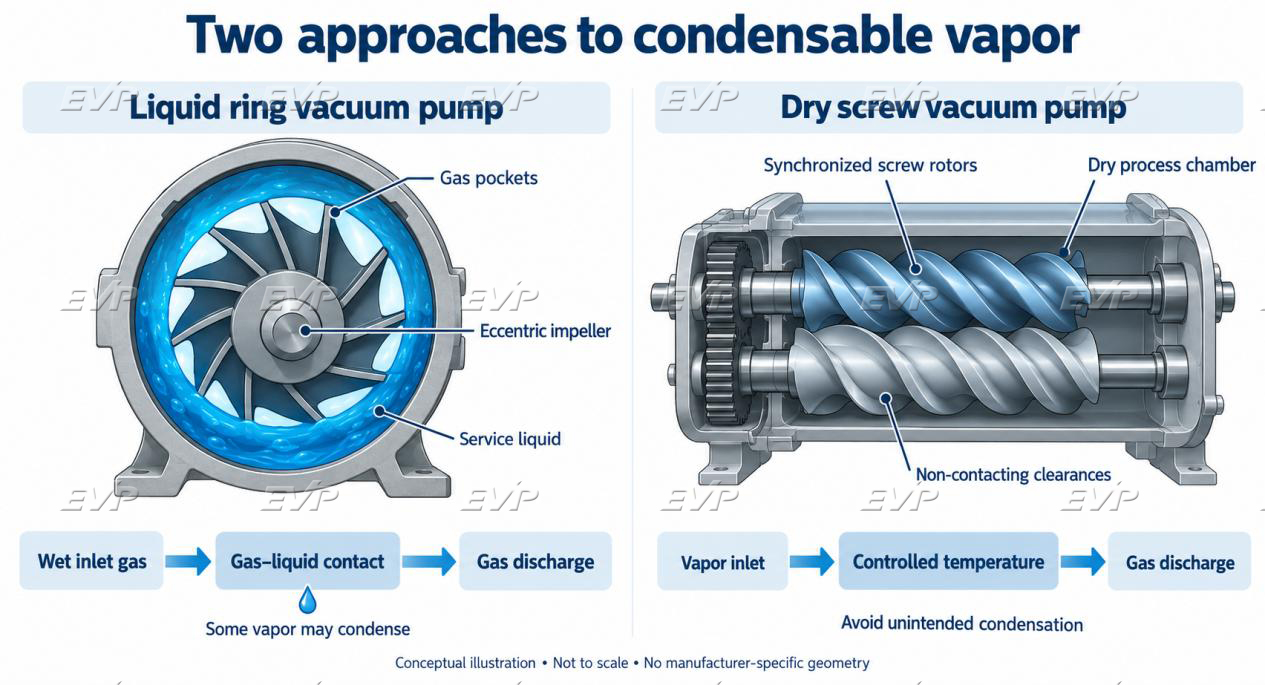
Liquid ring vacuum pumps are fundamentally wet, low-temperature machines that tolerate multiphase flow: the service liquid provides sealing and compression, while also absorbing heat inside the pump and promoting partial vapor condensation. Consequently, liquid ring pumps are generally more robust when the inlet gas is near saturation, the vapor load is high, or droplets and even occasional liquid carryover are present. Published industrial literature explicitly identifies condenser air-removal duties in which the non-condensable gases are fully saturated with vapor, and permits substantial amounts of liquid to enter with the gas. The trade-offs are the service-liquid system, gas–liquid separator, heat exchanger, water/contaminated-liquid treatment, and the limit imposed on ultimate vacuum by the vapor pressure of the service liquid.
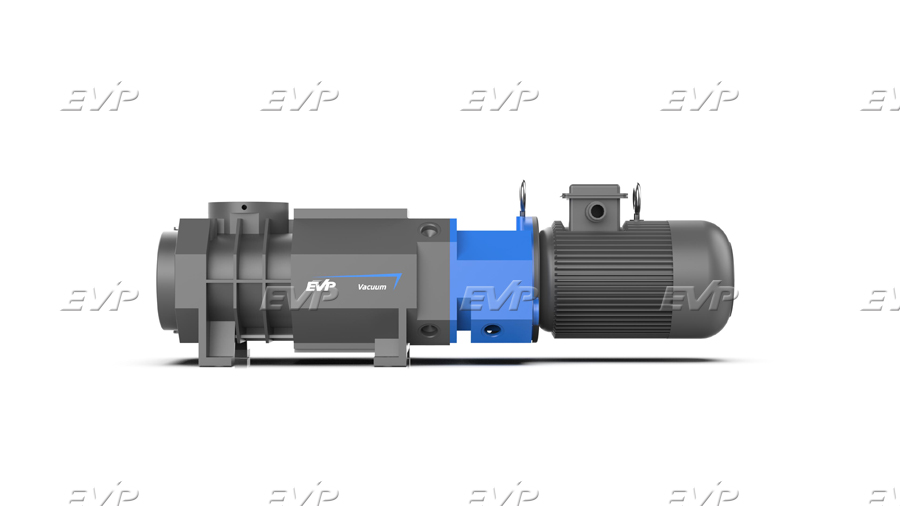
Dry screw pumps, by contrast, are dry machines with no process-contact service liquid, capable of deeper vacuum: two synchronized, non-contacting screw rotors trap and convey gas, and the compression chamber itself requires neither lubricating oil nor sealing liquid. They are particularly suitable for chemical, pharmaceutical, and freeze-drying processes that require freedom from sealing-liquid contamination, high-purity solvent recovery, minimized wastewater, and deeper vacuum. However, “dry” does not mean “unaffected by vapor”; on the contrary, for most condensable media, the design priority is to prevent condensation in the wrong location through pump-body temperature control, an inlet condenser, gas ballast/purging, insulation and heat tracing, and shutdown drying procedures. Published operating manuals explicitly require warm-up, gas ballast, and post-process drying/purging for condensable-vapor duties.
The most important engineering conclusions are as follows:
| Engineering criterion | Liquid ring | Dry screw | Practical implications for selection |
| Saturated vapor / high humidity gas | Very strong | Moderate; depends on thermal management | For large quantities of saturated water vapor, generally prioritize liquid ring pumps or upstream condensation |
| Continuous droplets / occasional liquid carryover | Very strong | Weak to moderate; the specific model must be verified | Where hydraulic shock is a risk, prioritize liquid ring pumps or improve gas–liquid separation |
| Clean organic solvents | Moderate to strong | Very strong | High value solvent recovery generally favors dry screw pumps + condensation |
| Deep vacuum | Average | Very strong | Single stage / two stage water sealed liquid ring pumps commonly achieve approximately 30–33 mbar(abs); dry screw pumps can reach well below 1 mbar, depending on the model |
| Tolerance of liquid at the inlet | High | Generally lower | One of the most important distinctions between the two equipment types |
| No process contact service liquid | No | Yes | Pharmaceuticals, fine chemicals, and solvent recovery often favor dry pumps |
| Wastewater / service liquid treatment | Higher | Lower | A closed loop liquid ring system can substantially improve this, but does not eliminate it entirely |
| Corrosion control | Materials + service liquid chemistry control | Materials / coatings + temperature + purging | Both require assessment based on the actual chemical system |
| Typical failure risks | Cavitation, scaling, service liquid overheating, mechanical seals | Condensation induced corrosion, polymerization / crystallization, rotor seizure, particle ingress | The phase state of the process medium often has a greater effect on reliability than the pump type itself |
| Maintenance complexity | Simple mechanical construction, but more auxiliary wet system equipment | Pump auxiliaries can be simpler, but rotor clearances / gearing / thermal management impose stringent requirements | Compare complete systems, not just bare pumps |
| CAPEX | Generally lower | Generally higher | Liquid ring pumps often have an advantage for high humidity, high flow rough vacuum duties |
| Life cycle cost | Depends on water, waste liquid disposal, and energy consumption | Depends on electricity, nitrogen, filtration, and overhaul costs | High value solvent recovery can quickly make a dry pump solution economically attractive |
For projects with no specified capacity, I recommend that the first question to suppliers should not be the “maximum permissible vapor percentage.” In isolation, this metric has almost no engineering significance. The tender data sheet should specify, at a minimum: kg/h or kmol/h of each gas component, absolute pressure, temperature, the partial pressure/dew point of each vapor, non-condensable gas load, continuous droplet loading, maximum instantaneous liquid carryover, solids content, target pressure, and startup and cleaning conditions. The ISO 21360 series specifies test methods for flow rate, base pressure, water vapor tolerance, and power for positive-displacement vacuum pumps; actual chemical process media nevertheless require additional process-specific verification.
All costs presented below are illustrative engineering estimates, not quotations; published data from different manufacturers have been normalized for use, and their product images, curves, and trademarks are not reproduced.
Operating Principles, Vapor Loads, and Vacuum Performance
The impeller of a liquid ring pump is mounted eccentrically in a pump chamber containing service liquid. Rotation forms a liquid ring, and the effective volume between the blades periodically increases and decreases to accomplish suction, compression, and discharge. Because the gas directly contacts the relatively cool service liquid, condensable vapor may condense at the inlet and during compression, reducing the gas volume that actually needs to be compressed. In some saturated-vapor applications, this even produces a so-called “capacity gain through condensation.” Liquid entering with the inlet stream generally does not immediately create the severe risks associated with dry machinery having precision clearances.
Recent multiphase-flow studies of liquid ring pumps also show that their performance is intrinsically governed by strongly coupled gas–liquid two-phase flow: inlet pressure, rotational speed, liquid ring shape, axial-clearance leakage, and transient gas–liquid interfaces all affect suction capacity and power, rather than the pump behaving as a simple “fixed-volume pump.” A three-dimensional multiphase-flow study published in 2021 and subsequent axial-clearance studies have both confirmed this.
Dry screw pumps form working chambers between two synchronized, counter-rotating, non-contacting screw rotors, conveying inlet gas axially toward the discharge side; the compression chamber contains no process liquid used for sealing or lubrication. Ultimate vacuum is closely related to rotor clearances, thermal deformation, backflow, and screw profiles. Recent experimentally validated models show that backflow, heat transfer, and thermal deformation are all important determinants of dry screw pump performance.
Vacuum Range Cannot Be Judged by “Ultimate Vacuum” Alone
| Parameter | Liquid ring | Dry screw |
| Typical ultimate pressures of publicly documented industrial models | Standard two stage units using water as the service liquid commonly achieve approximately 30–33 mbar(abs), depending on water temperature | Some publicly documented industrial models achieve approximately 0.01–0.1 mbar(abs) without gas ballast and approximately 0.5 mbar(abs) with gas ballast; these are model specific examples |
| With large quantities of condensable vapor | In pump condensation can reduce gas volume | Actual operating pressure may be far above the ultimate value; it is determined first by vapor partial pressure, dew point, and condenser capacity |
| Principal risks at low pressure | Cavitation, boiling of the service liquid | Backflow, thermal load, condensation / corrosion, gas ballast load |
| Methods of achieving deeper vacuum | Mechanical boosters, ejectors, or multistage systems | A single pump or a mechanical booster + dry backing pump |
The “ultimate pressure” must never be used directly for process selection. For example, a pump that reaches 0.05 mbar with dry air will not necessarily maintain 0.05 mbar when large quantities of water vapor or solvent vapor enter. This is precisely why ISO 21360-2 identifies water vapor tolerance as a performance parameter for positive-displacement vacuum pumps that is independent of base pressure.
Why Vapor Loads Rapidly “Consume” Pumping Speed
As a purely theoretical example, consider 100 kg/h of water vapor at 40°C, assuming that condensation has not yet occurred and using the ideal-gas approximation.
Then:
| Suction absolute pressure | Volumetric flow corresponding to 100 kg/h of water vapor |
| 100 mbar(abs) | ≈1,445 m³/h |
| 50 mbar(abs) | ≈2,890 m³/h |
| 20 mbar(abs) | ≈7,225 m³/h |
Thus, for the same 100 kg/h of vapor, reducing the pressure from 100 mbar to 20 mbar increases the inlet volumetric load by a factor of approximately 5, provided that the vapor still enters the pump in the gas phase.
This is also why an inlet condenser can sometimes be more important than simply increasing the vacuum pump size. Liquid ring pumps can use partial in-pump condensation to reduce the volume requiring subsequent compression, whereas dry screw pumps generally benefit from removing the vast majority of a high vapor load first at a controlled location, such as an upstream condenser, allowing only the remaining vapor and non-condensable gases to enter the pump. Industrial condenser air-removal literature likewise shows that vapor condensation upon entering a liquid ring pump can substantially reduce the gas volume actually handled by the pump.
Capacity should therefore be calculated using the following expression, rather than directly using the m³/h value on the equipment nameplate:
Total process load = non-condensable gases + air leakage + residual quantities of each condensable vapor + purge/gas ballast gas + startup transient load.
For liquid ring pumps, obtain performance curves corresponding to the actual service-liquid temperature and saturated-gas conditions. For dry screw pumps, in addition to pumping-speed curves, obtain guaranteed values for permissible vapor load in kg/h, permissible partial pressure, gas ballast flow, inlet temperature range, and continuous/instantaneous liquid tolerance.
Materials, Reliability, Energy Consumption, and Engineering Constraints
The two technologies have very different approaches to reliability. Liquid ring pumps are mechanically more forgiving, but transfer much of the complexity to the service-liquid system; dry screw pumps keep the process chamber “dry,” but require tighter control of temperature, particles, and liquid-phase formation.
| Item | Liquid ring | Dry screw |
| Liquid carryover | Among the highest levels of tolerance; can handle wet gas and some liquid ingress | Hydraulic shock should, in principle, be avoided; tolerance of small quantities of mist droplets must be confirmed for the specific model |
| Saturated water vapor | Very suitable | Can be handled, but generally relies on temperature control, gas ballast, and condensation management |
| Solids / crystalline material | More tolerant than dry screw pumps, but abrasion, blockage, and scaling can still occur | Precision clearances are more sensitive to solids; inlet screens / filters are generally recommended for dryer applications |
| Corrosion mechanism | Gas + condensate + service liquid all contact the metal; service liquid pH / chloride ion concentration / salt concentration are critical | Maintaining the gas phase can reduce liquid phase corrosion; once acidic / corrosive condensate forms, the risk can rise rapidly |
| Available wetted part materials | Published industrial configurations include austenitic stainless steel, duplex stainless steel, copper alloys, etc. | Typically use base materials + corrosion resistant surface treatments / special materials; suitability must be verified for the process medium |
| Process chamber lubrication | Service liquid participates directly in compression | No process contact lubricating oil |
| Bearing / gear lubrication | Bearings still require lubrication | Gears and bearings still require lubricating oil, but are isolated from the process chamber |
| Shaft seals | Mechanical seals are common; they are potential leakage and maintenance points | Shaft end seal / labyrinth / separation gas designs depend on the model; barrier gas is commonly provided for corrosive media |
| Temperature control priorities | Service liquid inlet temperature and heat exchanger capacity | Rotor / casing temperature window, cooling water, discharge temperature, heat tracing, and purging |
| Principal failure modes | Cavitation, impeller / port plate erosion, scaling, mechanical seal leakage, bearing failures, service liquid overheating, and impact caused by overfilling with liquid | Condensation induced corrosion, polymerization / crystallization, rotor jamming by foreign matter, rotor contact caused by thermal expansion, gear / bearing wear, inlet filter blockage, and cooling or purge failure |
Cavitation in liquid ring pumps deserves particular emphasis. Published operating literature identifies all of the following as hazardous conditions: suction pressure approaching the vapor pressure of the service liquid, excessively low non-condensable gas load, insufficient service-liquid flow, and excessively high service-liquid temperature. Thus, “the deeper the no-load vacuum, the better” does not apply to liquid ring pumps; it may instead drive the equipment into the cavitation region.
For dry screw pumps, the greatest concern is liquid-phase formation inside the equipment that was not anticipated in the process design. For organic acids, halides, corrosive solvents, or readily polymerizing monomers, whether condensation occurs often directly determines whether the pump operates for years or requires frequent cleaning/suffers seizure. Temperature control must therefore not be interpreted simply as “the hotter, the better”: published technical literature explicitly states that excessive cooling can cause condensation, while overheating can trigger polymerization, self-reaction, or other safety issues.
Chemicals and fine chemicals.
For reactors, distillation, solvent drying, and similar operations, dry screw pumps + inlet/discharge condensation often offer clear advantages where the principal objectives are clean solvent recovery, reduced solvent-containing wastewater, and deeper vacuum. Published chemical-equipment literature explicitly identifies dry screw pumps for complex chemical and solvent duties, with hazardous-area, cooling, and purge configurations. When a process frequently produces large quantities of water, brine, or droplets, and the final vacuum requirement is only tens to hundreds of mbar, liquid ring pumps are often more forgiving.
Pharmaceuticals.
Operations involving both solvents and powders, such as filter dryers and conical dryers, are typical dry screw pump applications, but the small clearances in dry pumps make inlet filtration critical. Published industry literature specifically states that dry screw pumps in powder-dryer applications should be protected by inlet screens/filtration. For freeze-drying, conventional systems normally rely on a condenser to capture most of the water vapor first; actual engineering examples using dry pumps to handle water vapor have also emerged in continuous freeze-drying development.
Food.
Evaporation, vacuum cooking, deaeration, and wet processes involving possible liquid carryover are better aligned with liquid ring characteristics; for freeze-drying or clean vacuum-packaging systems requiring freedom from process service-liquid contamination, dry technology is more attractive. Crucially, hygiene in food applications cannot be judged by “oil-free” alone: upstream gas–liquid separation, cleanable piping, condensers, and the hygienic boundary on the product side are equally important.
Pulp and paper.
Paper-machine forming sections, press sections, and rotary-drum vacuum filtration inherently involve substantial water carryover and continuous wet-gas loads, making them traditional strengths of liquid ring pumps. Published industry literature shows that liquid ring systems are widely used for forming-section dewatering, press-section transfer, and vacuum filtration. Here, the greatest optimization opportunity is often not to replace liquid ring pumps with dry screw pumps, but to examine air leakage, pipe diameter, separators, water temperature, capacity loss due to wear, and VSD control.
Power generation and geothermal energy.
Air removal from steam-turbine surface condensers involves small quantities of non-condensable gases coexisting with large quantities of water vapor, with the non-condensable gases often nearly saturated with vapor; this closely matches the low-temperature, multiphase-handling characteristics of liquid ring pumps. A study of a 117 MW geothermal unit also showed that optimizing the gas-removal system and using the spare capacity of existing liquid ring pumps could reduce motive-steam consumption by approximately 11,724 kg/h, equivalent to approximately 3.26 MW of generating capacity. This demonstrates that, in power-plant vacuum systems, “pump-type selection” often has to be optimized together with ejectors, condensers, and the non-condensable gas load.
The most common retrofit mistake is to select a replacement pump solely by the old pump’s nameplate pumping speed.
The actual suction load of an existing system may have changed completely because of heat-exchanger fouling, air leakage, piping pressure drop, higher water temperature, or increased process throughput. Before a retrofit, it is advisable to measure suction pressure, temperature, non-condensable gas mass flow, vapor flow, and liquid carryover, and then re-establish the system curve.
More appropriate hybrid configurations generally include:
| Hybrid configuration | Applicable duties | Primary purpose |
| Inlet condenser + liquid ring pump | High vapor load, wet gas, rough / medium vacuum | Reduce vapor mass load while retaining robustness under wet operating conditions |
| Inlet condenser + dry screw pump | Solvent recovery, pharmaceuticals, deeper vacuum | Condense at a controlled location to protect the dry pump |
| Mechanical booster + liquid ring backing pump | High pumping speed and lower pressure, with wet gas still present | Extend the low pressure capability of the liquid ring system |
| Mechanical booster + dry screw backing pump | Deep vacuum, high pumping speed, relatively clean processes | Reduce the volumetric load on an individual pump under deep vacuum conditions |
| Steam ejector + liquid ring pump | Power plants and wet vacuum duties with ample steam availability | Handle vapor and non condensable gases in stages |
| Two parallel process modes using liquid ring / dry pump systems | Wet startup of batch processes, followed by deeper vacuum in the later stage | Optimize the wet and drying stages separately |
The “liquid ring pump + dry backing pump” arrangement often mentioned by users should not be treated as a standard default configuration. Both can themselves operate as positive-displacement machines discharging to atmosphere; direct series connection requires verification of interstage pressure, compression ratio, discharge temperature, liquid migration, and backflow prevention. More common and clearer engineering arrangements use a mechanical booster as the upstream stage with a liquid ring or dry screw backing pump, or assign the two pump types to different process stages.
Selection Matrix and Control Strategies
The following matrix can be used to consider vapor load, liquid carryover, vacuum requirements, contamination control, and economics together. Star ratings indicate general engineering suitability, rather than a guarantee for a particular product.
| Typical operating conditions | Liquid ring | Dry screw | Recommended solution | Required / common accessories |
| Near saturated water vapor + non condensable gases, 30–300 mbar | ★★★★★ | ★★★ | Liquid ring preferred | Gas–liquid separator, service liquid heat exchanger, VSD, mist eliminator |
| Large continuous droplet load / possible liquid impact | ★★★★★ | ★★ | Liquid ring; high efficiency liquid separation is essential upstream of dry pumps | KO vessel, high high liquid level interlock, mist eliminator |
| Clean organic solvents, high recovery rate required | ★★★ | ★★★★★ | Dry screw pump + condenser | Inlet condenser, KO vessel, discharge condensation, inert gas ballast |
| Target <10 mbar, very little liquid carryover | ★★ | ★★★★★ | Dry screw pump or booster system | Condenser, VSD, gas ballast, mechanical booster as required |
| Highly corrosive wet vapor | ★★★★ | ★★★ | Depends on the corrosion mechanism | Corrosion resistant materials; compatible service liquid for liquid ring pumps, coatings / purging for dry pumps |
| Readily polymerizing monomer vapor | ★★★ | ★★★ | Cannot be decided by pump type alone | Precise temperature control, heat tracing, inhibitor / flushing, control of condensation location |
| Dryer exhaust containing dust / crystals | ★★★★ | ★★★ | Liquid ring more tolerant; enhanced protection needed for dry pumps | Filter / cyclone separation, differential pressure monitoring, reverse flow cleaning |
| High value pharmaceutical solvents | ★★★ | ★★★★★ | Dry pumps generally have greater advantages | Condenser, filtration, inerting, closed exhaust gas handling |
| Wet food processing / vacuum evaporation | ★★★★★ | ★★★ | Generally liquid ring | Separator, hygienic boundary design, heat exchanger |
| Freeze drying | ★★★ | ★★★★★ | Cold trap / condenser + dry pump is more common | Condenser / cold trap, filtration, VSD |
| Paper machine vacuum dewatering | ★★★★★ | ★★ | Liquid ring | Water separator, service liquid cooling, VSD |
| Steam turbine condenser air removal | ★★★★★ | ★★★ | Liquid ring or ejector + liquid ring | Condensation / separation, standby pump, anti cavitation control |
| Zero seal water discharge requirement | ★★ | ★★★★★ | Dry pump | Closed condensation, exhaust gas treatment |
| Extremely high vapor load, but readily condensable vapor | ★★★★★ | ★★★ | Condense first, then compare the two pump types | A large inlet condenser is the key equipment |
Published industrial literature and recent research on liquid ring and dry screw pumps jointly support this distinction: the advantages of liquid ring pumps arise from liquid-phase participation and multiphase capability, while those of dry screw pumps arise from the absence of process service liquid, precise dry gas conveyance, and deeper vacuum.
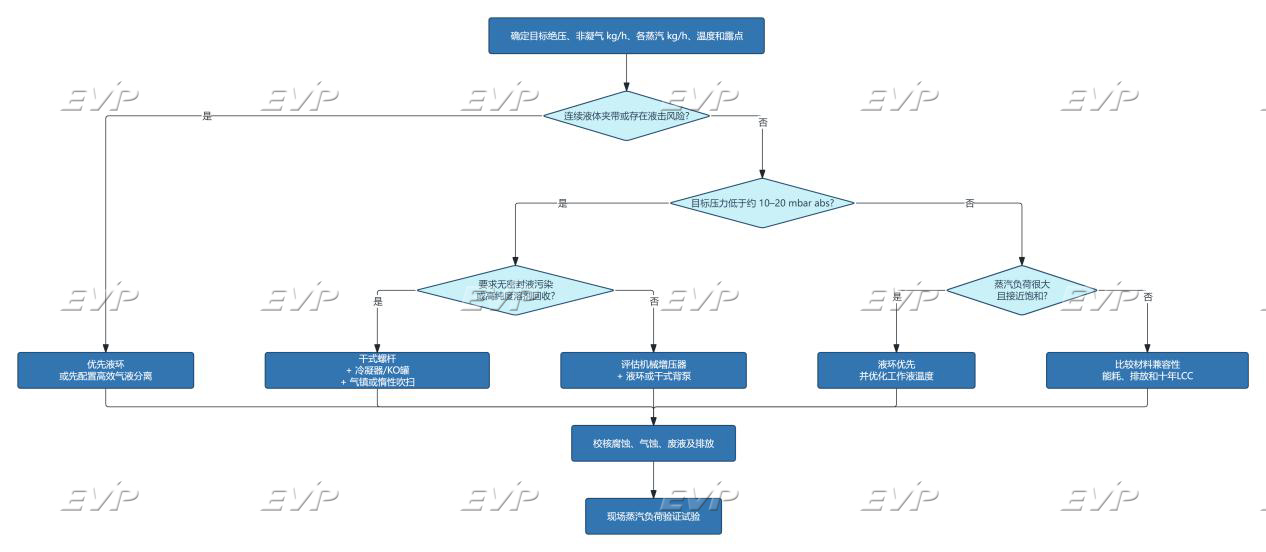
Control strategies should also vary with the technology.
For liquid ring systems, use inlet absolute pressure as the primary PID control variable and regulate speed through a VSD; simultaneously monitor service-liquid flow, inlet/outlet temperatures, separator liquid level, and heat-exchanger capacity. When suction pressure is low, service-liquid temperature is excessive, or signs of cavitation appear, do not simply continue increasing speed. Instead, resolve the issue by lowering service-liquid temperature, adjusting the anti-cavitation gas, checking the non-condensable gas flow, or changing operating conditions. Published operating literature explicitly identifies service-liquid vapor pressure approaching inlet pressure as a major cause of cavitation.
For dry screw pumps, a “state machine + pressure PID” approach is recommended instead of simple on/off control:
> Warm-up/purging → Enable process feed → Pressure PID/VSD operation → Activate gas ballast or inert purging at high vapor load → Stop process feed → Drying purge → Stop pump.
Some published operating manuals provide guidance for condensable-vapor applications involving warm-up periods of approximately 30 minutes and post-process drying/purging. This duration is only a model-specific example; projects should determine it from the equipment’s guaranteed values and on-site recovery tests.
Key interlocks should include inlet KO-vessel high-high liquid level, low cooling-water flow, high discharge temperature, high vibration, high motor current, high inlet-filter differential pressure, low inert-gas flow, and hazardous-gas detection. For readily condensing or crystallizing media, heat tracing/insulation of upstream piping and valves must also be incorporated into the control logic; otherwise, even the correct pump-body temperature cannot prevent condensation from occurring first in the inlet line.
Therefore, while capacity remains undefined, the most prudent decision principles can be summarized as follows:
> Wet, saturated, possible liquid carryover, tens to hundreds of mbar → Prioritize liquid ring pumps;
> Clean solvents, no service-liquid contamination, recovery required, deeper vacuum needed → Prioritize dry screw pumps;
> Both “large vapor load + deep vacuum” → Do not make either pump type bear the entire load; prioritize a condenser + staged/mechanically boosted vacuum system.